Well, it's evident how bad I am at communication. It would be a wonder if anyone is still looking at this. But in the case that they are, I`ll try to regurgitate a few events. It'll be pretty watered down.
Hof Louisgarde seems far behind now. I am currently in Bellinzona in the south of Switzerland. I enjoy ending up in places with almost no planning. Last week I got a ride into Bern with a Lebanese couple who seemed to think that making money and filling up empty space with lots of people was a pretty good idea, so I found an empty space on a park bench beside the roaring Aare for the night and met up with Matthias in the morning. We had enough time for coffee before we ran into the train station and headed for Zweisimmen. There we met up with a friend of Julia's who we planned on leaching mountain information off of. Joscha works the winter on the ski slopes on first aid. Because of his job he naturally has a pretty good conection with the helicopters and their pilots. He wanted to take us to see the company anniversary celebration. He said it was more like a little town gossip meeting on the airfield gawking at the millions of dallars that go whipping around the air picking up injured tourists. In the middle of the event about 6 paragliders could be seen decending from the mountains. Circling through the clouds and excecuting perfect landings right on the field beside. This truelly is a different place. Everything is governed by the mountains. The low houses all built with beautiful care. Everything wood, from the elaborate trim and shudders to the exactly six foot cielings to the cheese racks in the basement.
We headed up for a night in a hut that Joscha new. The switchback path up the mountain was just one trip too many for his subaru. Part way up the engine overheated. We gathered water from a streem and waited for the steam to clear. But no luck in starting it again. We rolled it off to the side so Joscha could roll with it back down the mountain to his house the next morning. We hadn't been walking for 5 minutes when a farmer picked us up. He was taking wood up to make a deck on his hut. I have been struggling with the swiss german accent, but that's only when they speek high german, when I heard Joscha and the farmer talk to each other in dialect... no chance of understanding.
Anyhow, we entered a new world for me up there in the clouds. I'm sure it's a stunning view when the sun is shining, but there was definately another magic about climbing over rocks and bolders, hearing the occasional bird and the bells of the cows on the hills below, and then from the cloud jumps a mountain goat and bounds across our path and leaps into the unknown on the other side.
We had planned on heading out from there for our hiking trip, but Joscha said we must go south, to Tissin, the Italian province. Withing a few hours we were on a train, enterred a long tunnel, and then popped out on the other side. In another world. It was Italy. Palm trees and medeteranian archecture. The wood huts were replaced with stone. Stone everything. The rooves are no longer spruce shingles but granite slabs blending into the mountains behind. We took a bus from Locarno to Brione and headed north up the valley until we came upon the perfect little hut. Surrounded by mountains on all sides and the roar of the river at it's source. The hut was equiped with everything from beds, wood stove, beer and wine, to an extra guitar. This was good thing because the weather was fowl. We spent a good deal of time relaxing in the hut. On one occasion we bit the bullet and headed into the rain for a hike none-the-less. I won't tell this whole story, pretty rediculous really. Lets just say we made a couple bad decisions and survived the most frightening hour and a half of our lives. The rice tasted mighty good that evening. Anyhow, that is a very watered down version, I'll just let you know I'm heading up to a little village a bit north of Locarno to work making hay on a farm for a while. Hopefully I'll make a bit of money.
Money and possessions are really taking their tole on my mind. I've got a one-way wallet in toursit country, dangerous. It was only in a youth hostel where I roomed with a wandering carpenter apprentice that my expensive way of travel really hit home. Germany still has quite a respect for the traditions of the tradeworkers. They nail their emblems on the birch may pole and wear their traditional clothing to work. The carpenters clothes are a white shirt with puffy sleeves, a heavy black vest with large silver buttons, a large rimmed black felt hat and black corderoy bellbottom carpenters pants. They travel only with three small bundles in handkerchiefs perched on their stick. One has a change of the traditional clothing, another a small sleeping bag, and the other their tools. Working their way from town to town. With my huge pack and guitar strapped to the outside, I felt embarassed and capitalistic.
I should really head out. Till next time,
Grüsse,
Stephan
Saturday, June 5, 2010

Thursday, April 15, 2010
Greetings from Hof Louisgarde
Hello all. Well alot of things have happened and I haven't had time to write much. A mountain decided to kick up a bit of dust resulting in many-a-stranded tourist. Suddenly the accessibility of this world was a little bit broken down.
But all was not lost. Somewhere just south of Würzburg, on a farm surrounded by forest, children are paddling a little raft and an old bathtub on the duck pond shaded by a huge willows and hanging birches. The sun beats down on me as I lay the last red clay tiles on the barn roof. The past couple weeks have blessed us with some of the clearest skies Hof Louisgarde has seen in a while. Well this place has had people on it since the 1100`s when it was first built as a monestary, but I meen since there have been airplanes. Thanks to the volcano, there was no more flightpath above us. But this week the traffic in the sky returned. And it was under the white and blue plaid sky that we made birch-tar yesterday. After reading about methods of tool-making thousands of years ago in the ice-man exhibit in Bad-Margetheim a few weeks ago, Theo, one of the kids here got excited about making birch-bark tar. So we found a method on the internet and collected some old birch-bark, (important that it's not from a living tree). I won't explain the method here, but basically you want to burn the birch-bark with little/no oxygen and so you end up with a thick black sticky pudding which you must cook to evaporate (and not inside because it's poisonous). This ends up like a puddy which you can use to bind and seal things. Next boat, no epoxy... hmm... worth a try.
Here there is much to do on the farm. I'm not involved with the agriculture portion, more the vegetable production and sale through weekly deliveries as well as a market stand every friday at the Waldorf school in Würzburg. The only Waldorf schools I have ever seen have all been small and very alternative. It's interesting to see a huge full-out school with some of the same ideas. I have't heard alot from it but I took a walk around after failing at selling cheese and vegetables (very bad with money math in my head). There were some neet workshops with wood, metal, and even stone carving. The windows look out over the city and you can see the castle on the next hill over.
Here a castle, there a schloss, they're everywhere. And what's great is that locals know and appreciate how beautiful these old buildings are. It doesn't just become background. I remember on the drive back from Dresden, seeing all the tiny little villages, red roofs cropping out the hills striped with wine rows, and a castle or old tower perched on every hilltop. What's more, on barn rooves and housetops amidst this pictureque scene, are solar panels. Everywhere solar panels. I think you're hopping onto a good band-wagon Mom and Dad.
Here neer Weikersheim, there's not a whole lot of wine. But lots of agriculture. Today we went with our bikes first to Burg Neuhaus and then the Tierpark neer Bad-Margetheim. We took the bike/agriculture paths south between the hills and then up to the Burg. The castle used to be the store-place for a large amount of money and valuables. Some of the ruins still stand, but much of the old stone was taken to rebuild what has become a large stable for horses. Seems like a dream job waking up in a beautiful fachwerk house high up on the hill to feed the horses that graze within the castle walls. We went further along the hill. The path cut through canola fields beginning to turn yellow and was lined with now bluming fruit trees. You could see far on all sides. Truelly a hot day, with hanggliders and birds dotting the sky.
I'm trying to paint a bit of a picture for you seeing as I have no camera with me, but I'll see if I can't borrow one soon.
There is one thing I've marked here that stands out for some reason, more than stinging nettles in soccer fields, or cottage cheese and Bärlauch, or digging up the ingredients for the Demeter preperate hiding in deer bladders and cow skulls. More than the first time driving a tiny little tractor with wagon of wood and some ripped jeans. More than the voice of the donkies and the roosters in the early morning. It's the call for dinner. Different places I've been have different ways of calling people together to eat. A sea conch in Quebec, a bull's horn in Nova Scotia, Oma's little dinner gong... and here, when the children are playing outside around supper, we ring the monestary bell up in the tower. The different sounds from different lands, of different people with different ideas, and it all seems to get tied together by the sound of people coming together to do the most basic of all essential things... eat. Wow, it always seems to go back to food with me.
Anyway, I'm not exactly sure where the next piece of this life will get sewed on to this quilt, but I'll let you know. I think it should involve some pretty sweet hiking as Matthias may be heading across the pond in the next month.
Anyhow, I'll head out for now... some advise for anyone that doesn't know where things will take them...in the words of one of the workers here, just befure he's going to split some cake or chocolate for a break...
Pas auf! Jetz gets los!
(Watch out! Here it comes!)
But all was not lost. Somewhere just south of Würzburg, on a farm surrounded by forest, children are paddling a little raft and an old bathtub on the duck pond shaded by a huge willows and hanging birches. The sun beats down on me as I lay the last red clay tiles on the barn roof. The past couple weeks have blessed us with some of the clearest skies Hof Louisgarde has seen in a while. Well this place has had people on it since the 1100`s when it was first built as a monestary, but I meen since there have been airplanes. Thanks to the volcano, there was no more flightpath above us. But this week the traffic in the sky returned. And it was under the white and blue plaid sky that we made birch-tar yesterday. After reading about methods of tool-making thousands of years ago in the ice-man exhibit in Bad-Margetheim a few weeks ago, Theo, one of the kids here got excited about making birch-bark tar. So we found a method on the internet and collected some old birch-bark, (important that it's not from a living tree). I won't explain the method here, but basically you want to burn the birch-bark with little/no oxygen and so you end up with a thick black sticky pudding which you must cook to evaporate (and not inside because it's poisonous). This ends up like a puddy which you can use to bind and seal things. Next boat, no epoxy... hmm... worth a try.
Here there is much to do on the farm. I'm not involved with the agriculture portion, more the vegetable production and sale through weekly deliveries as well as a market stand every friday at the Waldorf school in Würzburg. The only Waldorf schools I have ever seen have all been small and very alternative. It's interesting to see a huge full-out school with some of the same ideas. I have't heard alot from it but I took a walk around after failing at selling cheese and vegetables (very bad with money math in my head). There were some neet workshops with wood, metal, and even stone carving. The windows look out over the city and you can see the castle on the next hill over.
Here a castle, there a schloss, they're everywhere. And what's great is that locals know and appreciate how beautiful these old buildings are. It doesn't just become background. I remember on the drive back from Dresden, seeing all the tiny little villages, red roofs cropping out the hills striped with wine rows, and a castle or old tower perched on every hilltop. What's more, on barn rooves and housetops amidst this pictureque scene, are solar panels. Everywhere solar panels. I think you're hopping onto a good band-wagon Mom and Dad.
Here neer Weikersheim, there's not a whole lot of wine. But lots of agriculture. Today we went with our bikes first to Burg Neuhaus and then the Tierpark neer Bad-Margetheim. We took the bike/agriculture paths south between the hills and then up to the Burg. The castle used to be the store-place for a large amount of money and valuables. Some of the ruins still stand, but much of the old stone was taken to rebuild what has become a large stable for horses. Seems like a dream job waking up in a beautiful fachwerk house high up on the hill to feed the horses that graze within the castle walls. We went further along the hill. The path cut through canola fields beginning to turn yellow and was lined with now bluming fruit trees. You could see far on all sides. Truelly a hot day, with hanggliders and birds dotting the sky.
I'm trying to paint a bit of a picture for you seeing as I have no camera with me, but I'll see if I can't borrow one soon.
There is one thing I've marked here that stands out for some reason, more than stinging nettles in soccer fields, or cottage cheese and Bärlauch, or digging up the ingredients for the Demeter preperate hiding in deer bladders and cow skulls. More than the first time driving a tiny little tractor with wagon of wood and some ripped jeans. More than the voice of the donkies and the roosters in the early morning. It's the call for dinner. Different places I've been have different ways of calling people together to eat. A sea conch in Quebec, a bull's horn in Nova Scotia, Oma's little dinner gong... and here, when the children are playing outside around supper, we ring the monestary bell up in the tower. The different sounds from different lands, of different people with different ideas, and it all seems to get tied together by the sound of people coming together to do the most basic of all essential things... eat. Wow, it always seems to go back to food with me.
Anyway, I'm not exactly sure where the next piece of this life will get sewed on to this quilt, but I'll let you know. I think it should involve some pretty sweet hiking as Matthias may be heading across the pond in the next month.
Anyhow, I'll head out for now... some advise for anyone that doesn't know where things will take them...in the words of one of the workers here, just befure he's going to split some cake or chocolate for a break...
Pas auf! Jetz gets los!
(Watch out! Here it comes!)
Sunday, March 28, 2010
Berlin to the Banks of the Elbe and Back
Happy Easter to everyone who is celebrating Easter in any way. I have just come back to Speyer today to be with my grandparents for the weekend. Last week started with a one-way ticket to Berlin, more-or-less on a whim and a need to get out and see some things on my own.
Now, only a week-and-a-half later and I still have to spend time refelcting on the things I've seen and done, (as is the case with any trip), and the more you see and do, the more you realize all the things you've missed. But I'll focus on the things I didn't miss.
Well I've got to say that being a country-boy of sorts, I still always approach cities with a some-what "duck-and-cover" mentality, but also a guitar in hand. It takes a while for this little ground hog to venture far from it's hole. But when one has no "home hole" per se, you're left with no choice but to venture. This is when a place reveals its many faces. Needless to say Berlin has many. Take the one's with piercings and sad eyes half-covered by dirty pink mohawks for instance. These are the punks begging in subways and outside grocery stores. They have well-trained german-sheperds at their side and their expressions are more forlorn than the first time they drew the white "A" of anarchy on a cold brick wall I can imagine. The pan-handling has only come about in the past 5 years or so I'm told. A stroke of desperation. I guess it makes sense that there would be a greater concentration of absolute die-hard anarchists in this country's capitol considering the recent history. This city has seen first-hand the effects of an iron hand and it’s no surprise that a culture was born that will forfeit everything to live-up to ideals that give the finger to all forms of capitalism, power, and control. These may be assumptions however. But one can’t help but speculate when you see the thousands of square feet of graffiti scattered about this city. There were a few times when I just rode the S-bahn train like a tour-bus watching the city unravel itself before me in a scarf of graffiti. More evidence of an underground culture bursting at the seems with the need for expression. On abandoned buildings, concrete barriers, juxtaposed against buildings that are hundreds of years older.
That’s a whole other realm altogether; the juxtaposition of old and new. Another view of what history is, and just how fast it can change. It was just one year before I came into this world that champagne bottles and sledge hammers where brought out to mark the end of an era and the fall of a barrier so symbolic in everyone’s minds. Now you can go to Potsdammer Platz amongst the futuristic glass and steel and take a picture beside a man in Russian military uniform in front of one of the last remaining pieces of the great wall. Already a museum piece, It remains an obvious divide between good and bad in our minds. But how do you tell a child the difference between right and wrong? This question is evident when I talk with a woman who was just a child wearing the school uniform and appropriately coloured tunic, swearing allegiance to the state. Then one morning she learned she didn’t have to wear the tunic on Wednesdays. In fact they where all wrong and everything from before was bad, so just try to forget it. Except maybe free education, we’ll bring that back, and possibly music lessons, and child-care, etc. There are many difficult questions to ask when we find ourselves living history, and being part of change.
Speaking of change, I must let you know of my first positive experience with modern architecture. It was in the Berlin Jewish Museum. Designed by Daniel Libeskin, every inch of the new part was well-imagined. The building consists of intersecting wings and lines. Each main segment has a theme; Exhile, Holocaust, Continuation. They also rise and fall and intersect on different planes. The Continuation wing rises up stone steps to (ironically) some of the oldest Jewish history exhibits. At the end of the Holocaust wing is a large steel door opening into the Holocaust Tower. This tower is an unheated concrete tower with two of the walls meeting at a triangular point on one end. High up in the tower is a slim opening to the outside through which shines a dim and far-off light and one can hear the traffic and city sounds from outside. In the corner directly below the sliver of light is complete darkness. Sometimes it’s hard to look at a museum piece encased in glass and feel any form of context. But standing in the cold Holocaust tower, feelings are made concrete. This was so all throughout the museum. There were windows and mirrors brilliantly places which gave so many vantage points. One room was a war memorial. Another large concrete room with 10, 000 thick, steel faces scattered on the floor. People were free to walk upon the faces, and they did. But with every step came the clang of steel-on-steel. A disturbing symphony that made some people cringe as they heard the sound of each face reverberate. The message was clear, and every person could live and experience that message. Later in the Continuation wing, one could look through a small window way up in the war memorial room. The sounds were inaudible and the faces indiscernible, but the whole picture was right there, crystal-clear. This is what history should be. Stories that gives us windows and mirrors into what was, what is, and what could be.
One window into what was (and in my opinion “what is”) was the silent film “Metropolis” which I saw in the Babylon theatre. A great film from 1927 newly released with footage previously lost. The film is quite famous and was made with one of the largest budgets of its time. But like many silent movies, the most brilliant part was the music, performed live by an apparently famous silent film pianist. My first live silent film experience an absolute joy.
Well this is turning out to be quite long and I haven’t even got to Dresden yet. I’ll try to give a quick peek at some random sites:
Sigeuans, Gypsies… they play in the streets and subways. Dark eyes, bright smiles, and lightning fingers that rip impossible strips off violins and accordions. I feel like Monica looking at Menonites.
There is the canal-like river Spree that makes its way under old bridges and past the grandeur of Museum Island. Upon it floats old wooden barges designed like boats-in-bottles. The masts and rigging must be able to fold down to fit under the low-laying bridges. Over these bridges ride bicycles carrying hipsters and lovers, and a musician towing a double bass in a wagon, and a man in a suit and some supplies from the hard-ware store strapped to the frame. And I can’t forget some of the most hard-core bike couriers I’ve ever seen. With dirty capris and scull caps and the unmistakable courier-bags, they make pylons out of street-cars and loud Spanish school groups.
I tried busking for the first time. First under the false information that you don’t need a license I got kicked out of the subway. I tried some Jack Johnson in the schloss park, got myself in a Japanese photo album and made enough money for lunch. Had so much fun playing guitar that I did it again on the train all the way to Dresden. It was an empty car, a sunny day, and open eastern countryside. I went to Dresden more-or-less on a whim as well knowing basically nothing about the city. I imagined the new houses and buildings popping out of the ground like the image of the war in reverse in Kurt Vonnegut’s “Slaughterhouse Five.” There’s nothing quite like going to a place you have no clue about, turning a corner, and being hit with an absolutely stunning and surprising view. Despite the fire-bombing of ’45 that turned much of the city to molten, some has been saved and much rebuilt. Beautiful old buildings like the Frauenkirche and Katolischekirche are brilliantly reconstructed with bits and pieces of what was left behind. Concrete and stone band-aids fill the gaps between the original dark stones that overlook the flooded and grand Elbe river.
Amongst the beautiful buildings and cobblestone is something I haven't yet seen in any of the very few places I've seen in Germany; Abandonment. Houses gutted and burnt-out left as the backboard for bleached concert posters and broken glass. There are old factories behind broken brick walls left as a memory. Amongst them is a huge dome tower, standing like the ghost of an industrial cathedral.
Oh my, this is long, apologies. I should probably let you go. But I wish you all a happy Easter. Next-time will be shorter, I promise.
Bis dann,Tcheuss
Now, only a week-and-a-half later and I still have to spend time refelcting on the things I've seen and done, (as is the case with any trip), and the more you see and do, the more you realize all the things you've missed. But I'll focus on the things I didn't miss.
Well I've got to say that being a country-boy of sorts, I still always approach cities with a some-what "duck-and-cover" mentality, but also a guitar in hand. It takes a while for this little ground hog to venture far from it's hole. But when one has no "home hole" per se, you're left with no choice but to venture. This is when a place reveals its many faces. Needless to say Berlin has many. Take the one's with piercings and sad eyes half-covered by dirty pink mohawks for instance. These are the punks begging in subways and outside grocery stores. They have well-trained german-sheperds at their side and their expressions are more forlorn than the first time they drew the white "A" of anarchy on a cold brick wall I can imagine. The pan-handling has only come about in the past 5 years or so I'm told. A stroke of desperation. I guess it makes sense that there would be a greater concentration of absolute die-hard anarchists in this country's capitol considering the recent history. This city has seen first-hand the effects of an iron hand and it’s no surprise that a culture was born that will forfeit everything to live-up to ideals that give the finger to all forms of capitalism, power, and control. These may be assumptions however. But one can’t help but speculate when you see the thousands of square feet of graffiti scattered about this city. There were a few times when I just rode the S-bahn train like a tour-bus watching the city unravel itself before me in a scarf of graffiti. More evidence of an underground culture bursting at the seems with the need for expression. On abandoned buildings, concrete barriers, juxtaposed against buildings that are hundreds of years older.
That’s a whole other realm altogether; the juxtaposition of old and new. Another view of what history is, and just how fast it can change. It was just one year before I came into this world that champagne bottles and sledge hammers where brought out to mark the end of an era and the fall of a barrier so symbolic in everyone’s minds. Now you can go to Potsdammer Platz amongst the futuristic glass and steel and take a picture beside a man in Russian military uniform in front of one of the last remaining pieces of the great wall. Already a museum piece, It remains an obvious divide between good and bad in our minds. But how do you tell a child the difference between right and wrong? This question is evident when I talk with a woman who was just a child wearing the school uniform and appropriately coloured tunic, swearing allegiance to the state. Then one morning she learned she didn’t have to wear the tunic on Wednesdays. In fact they where all wrong and everything from before was bad, so just try to forget it. Except maybe free education, we’ll bring that back, and possibly music lessons, and child-care, etc. There are many difficult questions to ask when we find ourselves living history, and being part of change.
Speaking of change, I must let you know of my first positive experience with modern architecture. It was in the Berlin Jewish Museum. Designed by Daniel Libeskin, every inch of the new part was well-imagined. The building consists of intersecting wings and lines. Each main segment has a theme; Exhile, Holocaust, Continuation. They also rise and fall and intersect on different planes. The Continuation wing rises up stone steps to (ironically) some of the oldest Jewish history exhibits. At the end of the Holocaust wing is a large steel door opening into the Holocaust Tower. This tower is an unheated concrete tower with two of the walls meeting at a triangular point on one end. High up in the tower is a slim opening to the outside through which shines a dim and far-off light and one can hear the traffic and city sounds from outside. In the corner directly below the sliver of light is complete darkness. Sometimes it’s hard to look at a museum piece encased in glass and feel any form of context. But standing in the cold Holocaust tower, feelings are made concrete. This was so all throughout the museum. There were windows and mirrors brilliantly places which gave so many vantage points. One room was a war memorial. Another large concrete room with 10, 000 thick, steel faces scattered on the floor. People were free to walk upon the faces, and they did. But with every step came the clang of steel-on-steel. A disturbing symphony that made some people cringe as they heard the sound of each face reverberate. The message was clear, and every person could live and experience that message. Later in the Continuation wing, one could look through a small window way up in the war memorial room. The sounds were inaudible and the faces indiscernible, but the whole picture was right there, crystal-clear. This is what history should be. Stories that gives us windows and mirrors into what was, what is, and what could be.
One window into what was (and in my opinion “what is”) was the silent film “Metropolis” which I saw in the Babylon theatre. A great film from 1927 newly released with footage previously lost. The film is quite famous and was made with one of the largest budgets of its time. But like many silent movies, the most brilliant part was the music, performed live by an apparently famous silent film pianist. My first live silent film experience an absolute joy.
Well this is turning out to be quite long and I haven’t even got to Dresden yet. I’ll try to give a quick peek at some random sites:
Sigeuans, Gypsies… they play in the streets and subways. Dark eyes, bright smiles, and lightning fingers that rip impossible strips off violins and accordions. I feel like Monica looking at Menonites.
There is the canal-like river Spree that makes its way under old bridges and past the grandeur of Museum Island. Upon it floats old wooden barges designed like boats-in-bottles. The masts and rigging must be able to fold down to fit under the low-laying bridges. Over these bridges ride bicycles carrying hipsters and lovers, and a musician towing a double bass in a wagon, and a man in a suit and some supplies from the hard-ware store strapped to the frame. And I can’t forget some of the most hard-core bike couriers I’ve ever seen. With dirty capris and scull caps and the unmistakable courier-bags, they make pylons out of street-cars and loud Spanish school groups.
I tried busking for the first time. First under the false information that you don’t need a license I got kicked out of the subway. I tried some Jack Johnson in the schloss park, got myself in a Japanese photo album and made enough money for lunch. Had so much fun playing guitar that I did it again on the train all the way to Dresden. It was an empty car, a sunny day, and open eastern countryside. I went to Dresden more-or-less on a whim as well knowing basically nothing about the city. I imagined the new houses and buildings popping out of the ground like the image of the war in reverse in Kurt Vonnegut’s “Slaughterhouse Five.” There’s nothing quite like going to a place you have no clue about, turning a corner, and being hit with an absolutely stunning and surprising view. Despite the fire-bombing of ’45 that turned much of the city to molten, some has been saved and much rebuilt. Beautiful old buildings like the Frauenkirche and Katolischekirche are brilliantly reconstructed with bits and pieces of what was left behind. Concrete and stone band-aids fill the gaps between the original dark stones that overlook the flooded and grand Elbe river.
Amongst the beautiful buildings and cobblestone is something I haven't yet seen in any of the very few places I've seen in Germany; Abandonment. Houses gutted and burnt-out left as the backboard for bleached concert posters and broken glass. There are old factories behind broken brick walls left as a memory. Amongst them is a huge dome tower, standing like the ghost of an industrial cathedral.
Oh my, this is long, apologies. I should probably let you go. But I wish you all a happy Easter. Next-time will be shorter, I promise.
Bis dann,Tcheuss
Wednesday, March 17, 2010
First Landing
Well I thought I'd begin again with this whole "blog thing." I was reading Liam's blog of his adventures in Chile and decided it's nice to hear what people are up to. It'll be a tad harder to see what I'm up to seeing as I left my camera behind. I'll try my best with words and whatever else I can scrounge together. Seeing as some of the places around are pretty well-known, it's easy to let other tourists do the camera work for you. So here I cheated...
 What you see: The Altpörtel, (old portal) one of the last bits of the old medieval wall that surrounded the city of Speyer. Eventually the constant game of ping-pong between French and German occupation of the city took its toll and much was destroyed.
Just today Oma and I were having a discussion about the presence of German nationalism in German society today. The question being, do we continue rubbing out nationalistic slogans on statues and removing pre-war German literature from the cericulum and trying to drown all recolection of a stained past, or do we put it out in the open for all to see and discuss and understand how, and why history took its course?
As for the present, it's been spent alot on biking on the farmers roads between little villages and in the paths in the woods by the Altrhein. The Rhein river was dredged and straightened to ease the passage of large numbers of barges up and down the large river. Left over from this grand operation are the horseshoe curves that used to be the banks of the more meandering Old Rhine, or Altrhein.
Tscheuss
 What you see: The Altpörtel, (old portal) one of the last bits of the old medieval wall that surrounded the city of Speyer. Eventually the constant game of ping-pong between French and German occupation of the city took its toll and much was destroyed.
 What you don't see: Just how many people ride bikes here. It's wonderful. Not just intense hordcores with spandex and slick helmets, but regular business suits and stylish teenagers and old grandmothers and grandfathers.
I guess I might as well go from the beginning. It all started with a $400 one-way ticket to Brussels on Jet Airways, an Indian airline which I had previousely never heard of. The entire airport/airplane experience was rather a typical and mind numbing one. I've always been under the impression that sitting in a small and badly ventilated desk droor for 8 hours, hitting yourself over the head with a brick, and eating some stale bread does about as much for the mental and physical health as a plane-ride. This time was an especially bizzare experience though. Whilst strapped into the coffin-like seat surounded by eiry blue lights and having my senses accosted by terrible Bollywood films, (and some very strange curry I might add) I really got an uncomfortable feeling of being in some science fiction movie. No person should ever make a transatlantic voyage in one night, thousands of feet in the air, and feel colostrophobic and distracted from reality. Too wierd. I have to try to avoid that in the future.
Anyhow, that fealing ended when I got off the train in my mother's and grandparents' home town of Speyer. On the Rhine, a tad south of Mannheim. I have been here a couple times in the past with my family. So it was refreshing to see the familiar church towers popping into view.
I guess I might as well go from the beginning. It all started with a $400 one-way ticket to Brussels on Jet Airways, an Indian airline which I had previousely never heard of. The entire airport/airplane experience was rather a typical and mind numbing one. I've always been under the impression that sitting in a small and badly ventilated desk droor for 8 hours, hitting yourself over the head with a brick, and eating some stale bread does about as much for the mental and physical health as a plane-ride. This time was an especially bizzare experience though. Whilst strapped into the coffin-like seat surounded by eiry blue lights and having my senses accosted by terrible Bollywood films, (and some very strange curry I might add) I really got an uncomfortable feeling of being in some science fiction movie. No person should ever make a transatlantic voyage in one night, thousands of feet in the air, and feel colostrophobic and distracted from reality. Too wierd. I have to try to avoid that in the future.
Anyhow, that fealing ended when I got off the train in my mother's and grandparents' home town of Speyer. On the Rhine, a tad south of Mannheim. I have been here a couple times in the past with my family. So it was refreshing to see the familiar church towers popping into view.
Speyer is now celebrating its 900 year Jubileum. The history of this place goes back a good 1500 years. Most of it can be found in the heads of my grandparents, and they'll gladly let you know any piece of it you wish to hear. It's hard to get anywhere fast with my grandparents because they can't help but give a tour of where you are. Everything from when buildings were burned and rebuilt to the poets and bishops that inhabited them.
It truelly does feel different to be in a place were acounted history spans back further than 200 years. When standing by the shore of north Georgian Bay, there's a much different sense of where you are, and the thought of empires and wars are not under your feet.
Amongst the history lessons my grandparents tell are the stories of their own lives, and these are the stories that are so close and give persective on life and change and how history is really made. It's one thing looking at pictures in history books. But the date, November 9th, 1938 meens alot more when you're sitting drinking a little schnapps and listening to your grandfather describe the feeling when he and his brothers and parents looked out over the town and saw the smoke coming from the synogogue. Yesterday I bought groceries in the new complex that was built in the synogogue's place. Or how my great-grandmother threw the anti-semetic school textbook in the fire in rage the first time her son brought one home. The teacher said nothing however, for Frau Ruppert was well-known and respected in town.
Just today Oma and I were having a discussion about the presence of German nationalism in German society today. The question being, do we continue rubbing out nationalistic slogans on statues and removing pre-war German literature from the cericulum and trying to drown all recolection of a stained past, or do we put it out in the open for all to see and discuss and understand how, and why history took its course?
As for the present, it's been spent alot on biking on the farmers roads between little villages and in the paths in the woods by the Altrhein. The Rhein river was dredged and straightened to ease the passage of large numbers of barges up and down the large river. Left over from this grand operation are the horseshoe curves that used to be the banks of the more meandering Old Rhine, or Altrhein.

What you don't see: The woman in the Arberetum behind the Orangery, she's hugging a pine, and she probably thinks no one sees her.
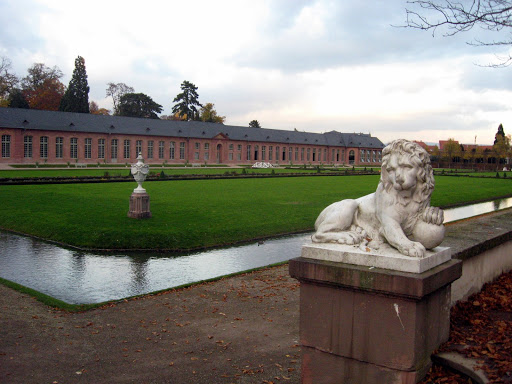
The other day I plodded around the biking paths and small farmers roads until I came to the Schwetzingen Schloss. It is an 18th century palace with quite an astounding and posh grounds. Here I've attached a couple pics, (once again, internet found). It is one of those show-off places that really does have something to show-off. I supose that was a favorite past-time of royalty in years past. Every turn there's something new. The prim French garden, the maze-like and half forested English garden behind. The Orangery, basically a green-house were they grow all sorts of exotic trees and plants including different citrus trees. There is the Arboretum. The Mosque, and the old ruins behind the small lake. Many kinds of different birds. Herons, geese and ducks of all sorts, peacocks, etc. A not-so-secret secret garden I supose. I sat on a bench and ate some bread and meat, and got rather lost on my why home. It's not a bad way to go about things really. Head out with all the time and intention of getting lost, succesfully accomplishing your goal, and finding something new in the process.
Tscheuss
Subscribe to:
Posts (Atom)